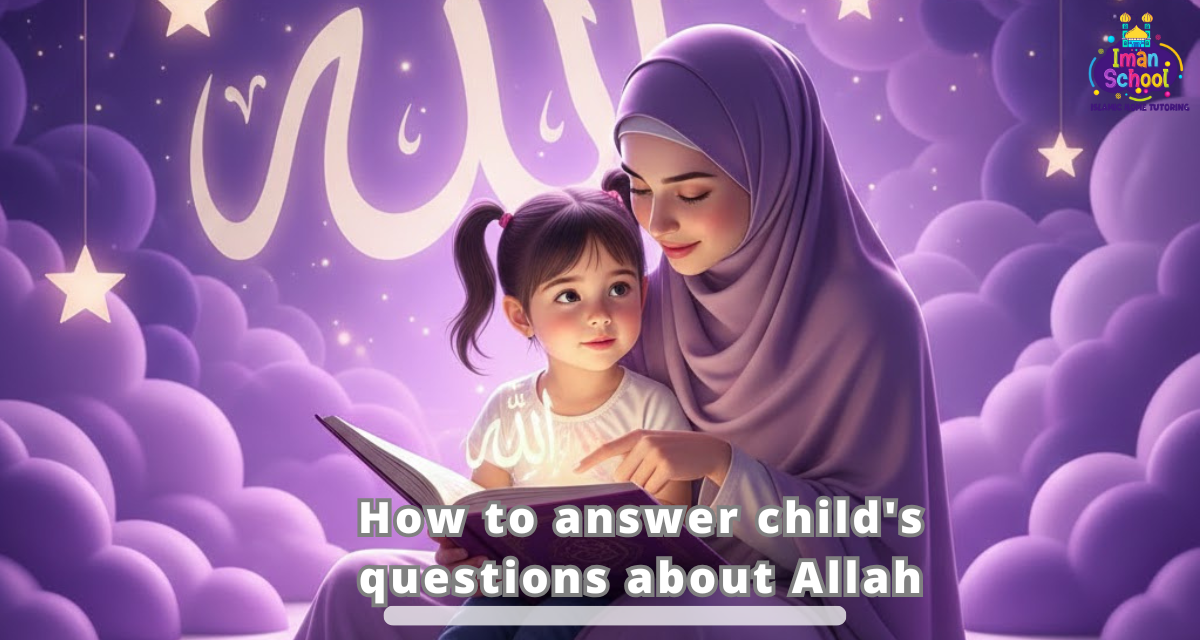
As your child grows, their natural curiosity rooted in their Fitrah (innate primordial disposition) will inevitably lead them to ask deep, existential questions. For many parents, this moment can be intimidating. However, learning how to answer child’s questions about Allah is one of the most sacred duties of a parent. It is the foundation of building Islamic identity in kids and ensures that their first connection to their Creator is built on clarity, love, and sound Age-appropriate Islamic theology.
In this guide, we will explore how to answer child’s questions about Allah using evidence from the Quran, the Sunnah, and the wisdom of classical scholars to help you navigate these conversations with confidence.
The Golden Rule: Be Honest, Be Simple, and Stay Calm
When considering how to answer child’s questions about Allah, the first step is your own reaction. Children are incredibly sensitive to your energy. If you look worried or hushed when they ask about the Divine, they may associate Allah with something "scary" or "off-limits."
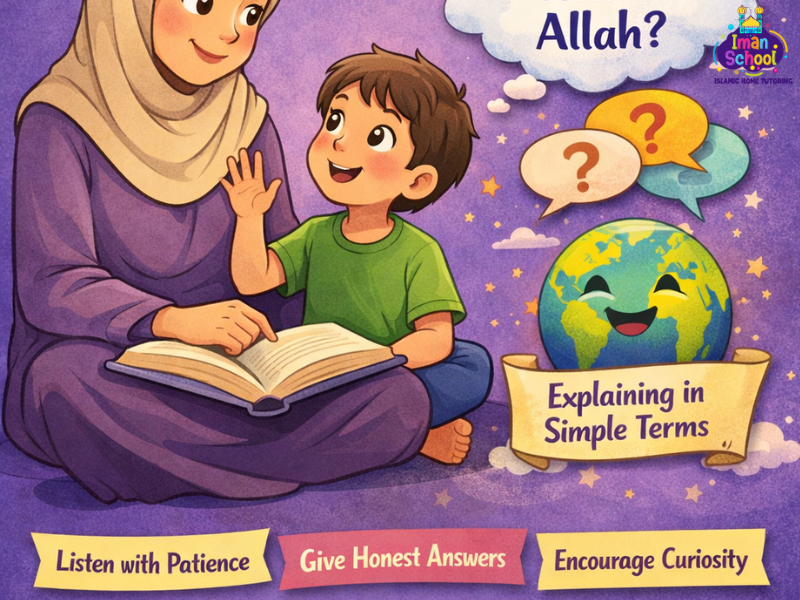
Validating a child's curiosity about Islam is essential. The Prophet Muhammad (PBUH) never discouraged questions. Instead, he encouraged seeking knowledge. Use simple analogies for Islamic creed to make abstract concepts tangible. As Imam Al-Ghazali suggested in Ihya Ulum al-Din, we must speak to people, especially children, according to the level of their intellect.
Learn Islam: Basic Islamic Questions and Answers
Answering "Where is Allah?": Proximity and Transcendence
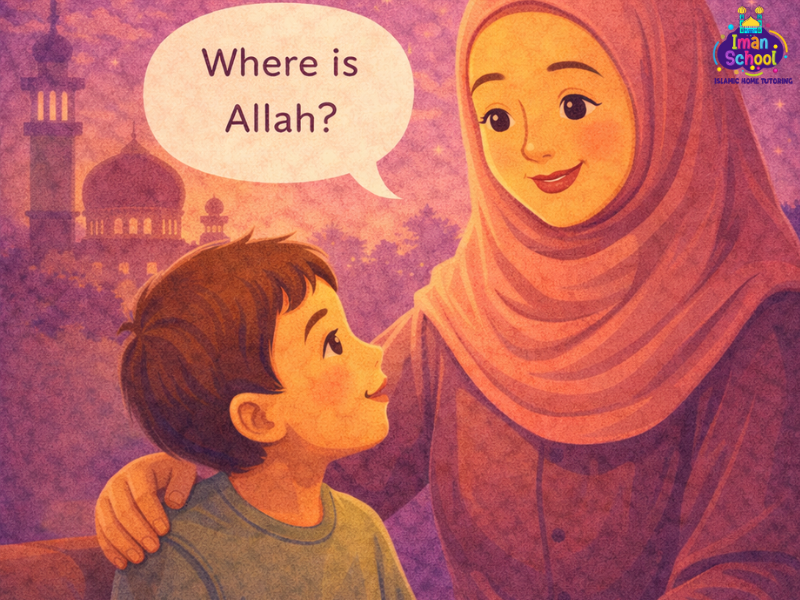
This is often the first hurdle in how to answer child’s questions about Allah. Children think in terms of physical locations.
The Scriptural Evidence: The Quran provides two dimensions of this answer. Allah is above His Throne (Istawa 'ala al-'Arsh - Surah Taha, 20:5) in His Majesty, yet He is with us through His knowledge and sight.
The Explanation: When explaining Allah to children, you can say: "Allah is above the heavens, on His Throne, because He is the King of everything. But even though He is high above, He is closer to you than your own heart because He hears your whispers and sees your every move." You can refer to the verse: "And He is with you wherever you are" (Quran 57:4).
Addressing "Who Created Allah?": The Concept of the First Creator
A child’s logic is cause-and-effect. They see a chair and know a carpenter made it; so they ask, "If Allah created us, who created Allah?" Knowing how to answer child’s questions about Allah in this context requires a firm grasp of Tawheed for preschoolers.
The Scholarly View: In Sahih Muslim, the Prophet (PBUH) warned that Shaytan would come to a person and ask, "Who created this? Who created that?" until he asks, "Who created your Lord?" The Prophet instructed us to seek refuge in Allah and say, "Amantu Billah" (I believe in Allah).
The Simple Explanation: Explain that Allah is the "First." Use the analogy of a train: if every carriage needs a carriage to pull it, the train will never move unless there is an engine at the front that moves by itself. Allah is the "Engine" that started everything but doesn't need anyone to start Him. He is Al-Khaliq (The Creator) for kids, the one who exists without a beginning or an end.
Get to know: Top 7 Easy Quran Surahs for Salah
Explaining "Why Can't We See Him?": The Limitations of Sight
"Can we see Allah?" is a question that requires explaining the unseen to children without making Allah sound non-existent.
The Scriptural Evidence: "Vision perceives Him not, but He perceives [all] vision" (Quran 6:103).
The Simple Explanation: When nurturing a child's love for Allah, explain that our eyes are like small batteries. They are strong enough to see the toys and trees, but they aren't strong enough yet to look at the Greatness of Allah. Use the sun as an analogy: "We know the sun is there because we feel its warmth and see its light, but if we stare directly at it, it hurts our eyes because it’s too powerful. Allah is much more powerful than the sun!" This is a cornerstone of how to answer child’s questions about Allah effectively.
View: Islamic Parenting in the West
Teaching Through the 99 Names: Focus on Love and Mercy
A vital part of how to answer child’s questions about Allah is introducing Allah’s names to toddlers. Focus on the names that inspire comfort.
-
Ar-Rahman & Ar-Raheem: Focus on His mercy.
-
Al-Wadud: The Most Loving. Tell your child that Allah loves them more than seventy mothers!
-
As-Sami' & Al-Basir: The One who always listens to their prayers.
By teaching kids about God in Islam through these names, you move away from a "fear-based" relationship and toward one of adoration and trust.
Read also about: Teaching Halal and Haram for Kids
Connecting Allah to the Natural World
Use nature as a tool to teach about the Creator. If your child sees a beautiful flower or a massive mountain, use that as an opportunity for Islamic parenting: religious questions. Ask them: "Who gave the bird its wings?" or "Who made the rain fall to help the flowers grow?"
This strengthens the Fitrah of a child by showing them that the world is a gallery of Allah’s work. Islamic storytelling for spiritual growth should always include stories of the Prophets and how Allah protected them using nature (like the spider's web for Prophet Muhammad PBUH).
See also: Seerah of Prophet Muhammad for kids
Balancing Hope and Fear: Emphasizing Reward over Punishment
In how to answer child’s questions about Allah, many parents make the mistake of using "Allah will burn you" as a disciplinary tool. This is contrary to the Sunnah. The Prophet (PBUH) said: "Make things easy and do not make them difficult, cheer people up and do not drive them away" (Sahih Bukhari).
When teaching Allah’s mercy vs. Allah’s punishment, always lead with Mercy. Jannah should be the primary focus for a child. Let them know that Allah wants them to succeed and that He is "Al-Ghafur" (The Most Forgiving) whenever they make a mistake.
When You Don't Have the Answer: "Let's Find Out Together"
Part of how to answer child’s questions about Allah is admitting when you are stuck. Answering difficult questions about Islam with "I don't know, let's ask a teacher or look in a book" teaches your child the etiquette of seeking knowledge. It shows them that Islam is a vast sea of wisdom and that even adults are still learning.
Explore our Islamic courses for children
Related topics:
- Teaching Children to Speak the Truth
- Rewarding Muslim Children for Quran and Salah
- Raising Muslim Children in the West
- How Do You Perform Wudu
- Islamic values for children
- Arabic Numbers 1 to 10 for Beginners
- The Best Dua for Children
- Top 10 Easy Hadith to Memorize for Kids
- Tashahhud in Prayer
Master Islamic Parenting and Education with Iman School
Are you looking for professional guidance on how to answer child’s questions about Allah and provide your children with a world-class religious foundation?
Iman School is the best online Islamic school specializing in Age-appropriate Islamic theology and Quranic studies for children. We don't just teach the Quran; we focus on nurturing a child's love for Allah and strengthening the Fitrah of a child through interactive, engaging lessons.
Our Online Quran classes with Female Tutors and specialized Islamic studies for kids are designed to help your child find answers to their most difficult questions in a supportive environment.
Enroll in Iman School today and give your child the gift of a confident Islamic identity.
Learning how to answer child’s questions about Allah is a journey of spiritual growth for both the parent and the child. By providing a Where is Allah? (Child-friendly answer) and explaining Who created Allah? (Simple explanation) with love and patience, you are planting seeds of Iman that will grow into a strong, unwavering tree of faith.