
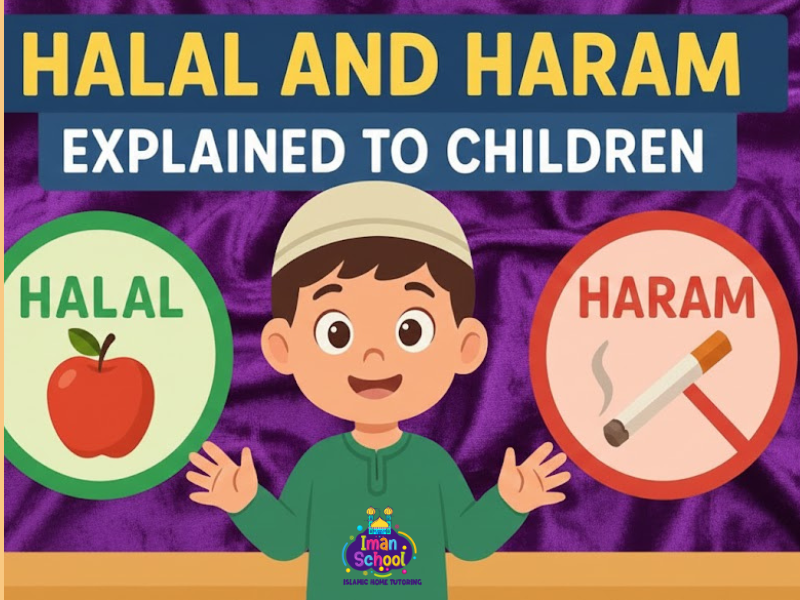
Teaching Halal and Haram for kids is an essential component of Islamic parenting boundaries and character development. It is far more than just teaching prohibitions; it's about instilling a love for what Allah loves and an aversion to what displeases Him. This guide provides practical, detailed advice for parents in the West on how to explain these core Islamic rules for kids with wisdom and compassion.
What is the meaning of the words Halal and Haram?
Before diving into the specifics of Halal and Haram for kids, parents must understand the fundamental linguistic and religious meanings:
-
Halal (حلال): Literally means "lawful" or "permissible." In Islam, Halal is any act, object, or food that is permitted and sanctioned by Allah (SWT). It represents goodness, purity, and blessing.
-
Haram (حرام): Literally means "forbidden" or "sanctified/sacred." In this context, it refers to any act or thing strictly prohibited by Allah. Engaging in Haram incurs sin, but avoiding it out of obedience brings immense reward.
Read about: Islamic Parenting in the West
What is the simplest way to explain Halal and Haram to a child?
The simplest way to explain Halal and Haram for kids is to use an analogy they can immediately grasp, fostering simple Islamic ethics for children:
The Traffic Light Analogy (Ages 4-7)
- Green Light (Halal): "These are the things Allah loves for us to do! It makes us happy and healthy, like smiling or eating healthy food." (Encourages Halal vs Haram activities for kids that are positive).
- Red Light (Haram): "These are the things Allah asks us to stop doing because they hurt us, hurt others, or hurt our hearts, like lying or taking someone's toy."
- Yellow Light (Makrūh/Makrūh Taḥrīmī): "These are things that aren't strictly forbidden but are disliked by Allah, and we try to stay away from them."
The Garden Analogy (Ages 8+)
- "Imagine our life is a beautiful garden given to us by Allah. Halal are the beautiful, healthy plants we water and grow (like honesty and prayer). Haram are the thorny weeds that hurt our hands and ruin the garden (like cheating or backbiting). The goal is to keep the weeds out to protect the beautiful garden." This helps them internalize the concept.
This approach provides a solid foundation for teaching Halal and Haram simply.
Get to know: Best Dua for Children
What are the most important Haram behaviors to teach first?
When teaching Halal and Haram for kids, prioritize Haram behaviors that directly impact their character and relationship with others:
Lying
Use the Hadith about lying for kids to explain that lying destroys trust, not just with people, but with Allah. Practical Example: If a child denies breaking a vase, affirm that admitting the mistake is Halal and brings more reward than lying, which is Haram.
Gheebah (Backbiting)
Use the Qur'anic analogy of eating the flesh of one's dead brother (Qur'an 49:12). Practical Example: When a child criticizes a friend, ask them, "Would you want to eat rotten meat?" This graphic imagery helps in teaching children about Gheebah (backbiting) effectively.
Shirk (Polytheism)
This is the greatest sin. How to explain Shirk to a child? Focus on the concept of Tawheed first (Allah is One, He created everything). Haram Example: Explain that worshipping toys or thinking cartoons have the power of God is wrong because only Allah can do that. Focus on the positive power of Allah.
Discover: Top 10 Easy Hadith to Memorize for Kids
How do I teach Halal and Haram food rules for kids?
Teaching Halal and Haram food rules for kids is a daily necessity in the West.
The Bismillah Rule
Always start with the Halal foundation: everything is Halal unless specified otherwise. Teach them to say Bismillah before eating anything.
The Pigs and Alcohol Rule
Explain that Allah has prohibited pigs (pork/gelatin) and intoxicants (alcohol) for reasons of purity and health. Practical Example: When they ask about gummy bears, explain, "This candy uses pig parts (gelatin), and Allah only wants us to eat what is clean and pure. We choose the Halal version because it pleases Allah."
Reading Labels
For older children (10+), turn shopping into a learning opportunity. Teach them how to identify ingredients like 'gelatin' or 'animal shortening.' This empowers them to adhere to Halal and Haram food rules for kids independently.
How to handle peer pressure related to Haram activities in school?
This is where the principles of Muslim parenting rules for behaviour are tested. The response must be empathetic yet firm:
-
Acknowledge and Validate: "I know it feels hard when your friends are doing something different." Acknowledge the pain of exclusion.
-
Focus on Allah’s Approval: "Your friends might think it's fun, but you know that choosing Halal is a reward from Allah. Would you rather have the temporary fun of your friends or the reward of Allah?" This is key to raising righteous children moral code.
-
Provide Alternatives: Instead of just saying no, teach them a Halal alternative. Practical Example: If friends are playing a prohibited video game, suggest a Halal entertainment for children alternative game or activity they can lead at recess.
-
Use Seerah Stories: Connect their situation to the Prophet (PBUH) or Companions who stood alone for the truth. This provides positive role models.
Learn more about: Seerah of Prophet Muhammad for kids
Is watching certain TV shows Haram for kids?
The ruling on Halal entertainment for children depends on the content:
Haram Content
Shows that promote polytheism, nudity, excessive violence, or behaviors contrary to Islamic morals (like disrespecting parents). Action: Explain that these shows fill the heart with bad ideas, which is displeasing to Allah. Set clear Islamic guidelines for children's toys and media.
Makrūh Content (Disliked)
Excessive time spent watching TV, even if the content is neutral, because it leads to wasting time that could be spent on worship or learning. Action: Set time limits and prioritize beneficial activities like reading or family time.
Also see: Raising Muslim Children in the West
How can I motivate my child to choose Halal over Haram?
Motivation for Halal and Haram for kids should be driven by love, not fear:
-
Focus on Reward: Constantly emphasize the rewards of Halal. Practical Example: When a child shares a toy, say, "Masha'Allah! When you share, Allah loves you more, and you get a palace in Jannah for this action!"
-
Avoid Islamic Discipline without Fear: Do not threaten Hellfire for simple mistakes. Instead, frame mistakes as learning opportunities and use immediate, short consequences that teach responsibility.
-
Positive Reinforcement: Shower them with praise and Duas when they make a difficult Halal choice. Use Islamic moral stories for kids that end with a reward for the righteous character.

Get to know: Rewarding Muslim Children for Quran and Salah
Halal and Haram for Kids: When should I introduce the rules about modesty?
The rules of modesty (Haya) should be introduced early and gradually:
-
Ages 3-6 (Body Ownership): Teach them that certain body parts are private and must always be covered, even from siblings, focusing on respecting their own and others' bodies. This is the starting point for teaching Akhlaq to children.
-
Ages 7-9 (Separation): Introduce simple concepts of interacting with the opposite gender (non-mahram), such as lowering the gaze and respecting distance.
-
Ages 10+ (Puberty): This is the time to introduce the full rulings of the Hijab and modesty, linking it to the age of accountability (Mukallaf).
FAQs about Halal and haram for kids
What is the best way to correct my child when they do something Haram?
The best way is to apply the Prophetic method: address the action, not the child. Correct privately, gently, and immediately. Focus on the moral error. Example: Instead of, "You are a bad child for yelling," say, "Yelling is Haram because it hurts feelings. Allah wants us to speak softly." Follow up with a simple Dua for them.
How do I teach my child that Haram things are not necessarily evil, but disallowed?
Explain the concept of Haram as a boundary set by the Creator, like a safety barrier on a cliff. The prohibited thing itself (like a type of meat or a loan with interest) might seem neutral, but crossing the boundary is dangerous to our faith and soul. We obey because Allah is All-Wise, not because we fully understand the potential harm. This addresses the challenge of Halal and Haram explained for beginners.
At what age should a child become accountable (Mukallaf) for Haram actions?
A child is held accountable (Mukallaf) for Haram actions after they reach puberty (usually between ages 11 and 15). However, age to teach Halal and Haram should begin much earlier (around age 4 or 5), preparing them gradually for that responsibility. The goal is to establish the habit before the obligation.
How do I respond if a non-Muslim friend tells my child something is Halal when it is Haram?
Teach your child to politely say, "Thank you for the advice, but for me, as a Muslim, I follow the rules set by God, and He has taught me that is not permissible." Reaffirm that your family follows Islamic moral education for children which comes directly from the Qur'an and Sunnah, not personal opinion.
Get to know: How Do You Perform Wudu
Enroll Your Child in Our Online Islamic Ethics Course
Are you looking for a structured, professional guide to support you in teaching Halal and Haram for kids?
Iman School offers an exceptional Online Islamic Ethics Course designed to instill the simple Islamic ethics for children and the Halal and Haram explained for beginners methodology. Our expert tutors use engaging Islamic moral stories for kids and interactive activities to systematically build your child’s moral compass based on authentic Islamic teachings.