When studying the foundations of faith, one of the most common questions students ask is: what is the actual Difference between a Prophet and a Messenger? While both are chosen by Allah to guide humanity, understanding the Difference between a Prophet and a Messenger is essential for a complete grasp of the Theology of Prophethood (Nubuwwah). This distinction helps us appreciate the various levels of responsibility given to these holy men throughout history.
The True Distinction Between a Prophet and a Messenger
It is commonly stated that the difference between a Prophet and a Messenger is that a Messenger receives a revealed law and is commanded to convey it, while a Prophet receives revelation without being commanded to convey it. However, this distinction is problematic, since a Prophet is also commanded to call people to Allah, convey the divine message, and judge among them according to what Allah has revealed.
For this reason, Shaykh al-Islam Ibn Taymiyah clarified that the more accurate view is that a Messenger is sent to a disbelieving people, whereas a Prophet is sent to a believing people, following the same Shari‘ah brought by the Messenger before him, in order to teach them and judge between them. As Allah says:
“Verily, We did send down the Torah to Moses, therein was guidance and light, by which the Prophets who submitted themselves to Allah judged for the Jews” (Al-Ma’idah 5:44).
Thus, the Prophets of the Children of Israel judged according to the Torah that Allah revealed to Moses.
Nabi vs Rasool in Islam: Understanding the Terms
In Islamic terminology, the Difference between a Prophet and a Messenger is often explained through the terms Nabi and Rasool. To understand the Difference between a Prophet and a Messenger, we must first look at their definitions.
Definition of a Prophet (Nabi)
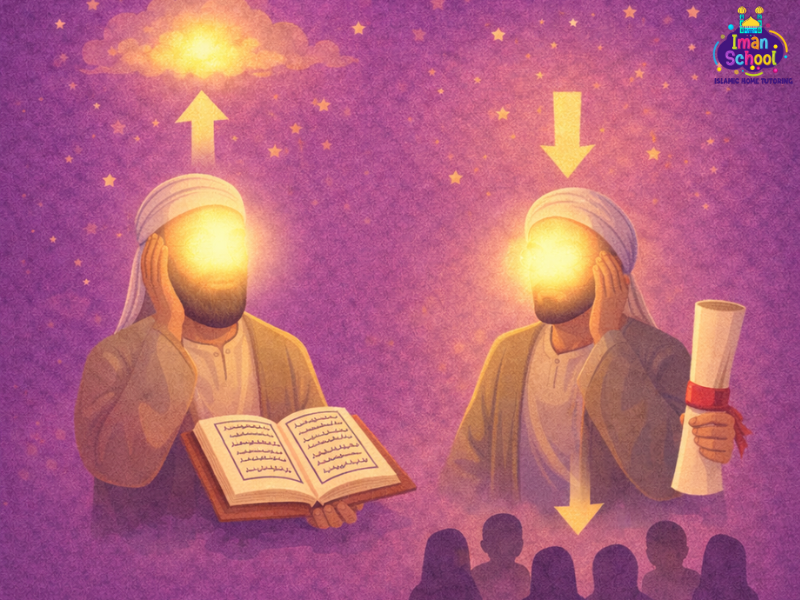
A Nabi is a man chosen by Allah to receive Revelation (Wahy) in Islam and is commanded to convey it to his people. However, a Prophet usually follows an existing Sharia (divine law) established by a Messenger before him. For example, many of the Prophets mentioned in the Quran who came after Musa (AS) were sent to call the Israelites back to the laws of the Torah.
Definition of a Messenger (Rasool)
A Rasool is a Prophet who is given a New Sharia and often one of the Divine books sent to Messengers (such as the Torah, Psalms, Gospel, or Quran). The Difference between a Prophet and a Messenger lies in the scope of their mission; a Rasool is typically sent to a nation that has entirely rejected the truth or has never received a law.
Get to know: the first Muadhin in Islam
Is every Messenger a Prophet?
A vital rule in Islamic Creed (Aqidah) regarding Messengers is that every Messenger is a Prophet, but not every Prophet is a Messenger. This is a fundamental part of the Difference between a Prophet and a Messenger.
Key Attributes of Prophets and Messengers
-
Infallibility (Ismah) of Prophets: Both are protected from committing major sins or errors in conveying the message.
-
Miracles (Mu'jizat) of Messengers: While all can have miracles, the Miracles (Mu'jizat) of Messengers are often public and world-changing to prove the validity of a new law.
-
Finality of Prophethood (Khatm an-Nubuwwah): All Muslims believe that Prophet Muhammad as a Prophet and Messenger is the final one sent to mankind.
Also read about: How many wives did Prophet Muhammad have
Core Differences in Mission and Message
The Distinction between Nabi and Rasool in Hadith further clarifies the Difference between a Prophet and a Messenger. According to some traditions, the total Number of Prophets and Messengers in Islam is approximately 124,000 Prophets, while only 313 were Messengers.
|
Feature |
Prophet (Nabi) |
Messenger (Rasool) |
|
New Law |
Follows an existing Sharia |
Brings a New Sharia |
|
Scripture |
Rarely given a new book |
Usually given Divine books |
|
Audience |
Believing people needing guidance |
Often disbelieving nations |
|
Precedence |
Lower in rank than a Rasool |
Higher in rank |
The highest among the Messengers are known as the Ulul 'Azm (The Arch-Messengers). These five—Nuh, Ibrahim, Musa, Isa, and Muhammad (PBUT)—displayed the greatest patience in their unique missions.
See: How long did it take Noah to build the ark
Why Understanding the Difference between a Prophet and a Messenger Matters
Whether you are teaching Stories of the Prophets for kids or studying Islamic Creed (Aqidah) regarding Messengers as a revert, knowing the Difference between a Prophet and a Messenger clarifies the history of guidance. It shows that Allah’s mercy is constant: He sends Prophets to maintain the truth and Messengers to re-establish it when it is lost.
Explore our Islamic courses
FAQ about Difference between a Prophet and a Messenger
What is the main Difference between a Prophet and a Messenger?
The main Difference between a Prophet and a Messenger is that a Messenger brings a new law and book to a disbelieving nation, while a Prophet reinforces an existing law among a believing community.
Who are the Prophets mentioned in the Quran?
There are 25 specific names mentioned, ranging from Adam (AS) to Muhammad (PBUH). Each demonstrates the Attributes of Prophets and Messengers like honesty and bravery.
Learn more about: Khadija bint Khuwaylid
Deepen Your Faith with Iman School
Are you ready to explore the Theology of Prophethood (Nubuwwah) and the Difference between a Prophet and a Messenger in more detail?
Iman School is the best online school for Islamic Studies and Arabic. We offer structured, authentic courses on Islamic Creed (Aqidah) regarding Messengers, the Seerah, and Tajweed. Our expert tutors make the Difference between a Prophet and a Messenger and other complex topics easy to understand for adults and children alike.