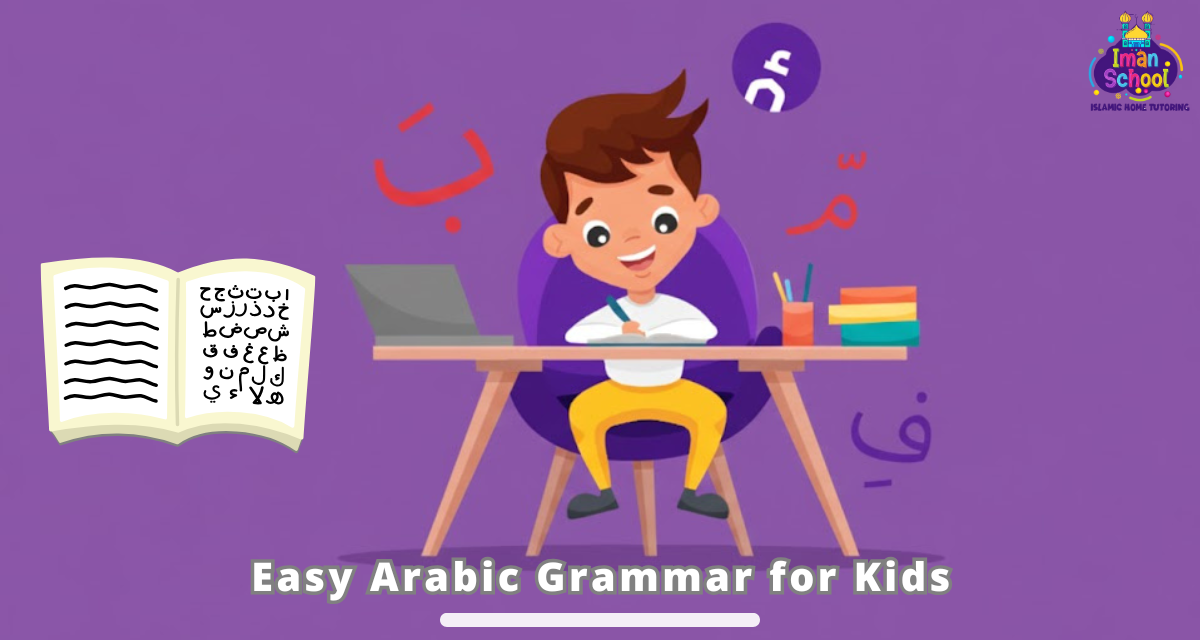
Easy Arabic Grammar for Kids is the foundation for turning individual Arabic words into meaningful communication. While grammar might sound intimidating, for children, it can be introduced naturally through simple, engaging concepts and real-life examples. Learning basic Arabic grammar lessons for children should feel like assembling blocks, not solving equations.
This guide breaks down ten core grammatical concepts to make Easy Arabic Grammar for Kids accessible and enjoyable.
Singular and Plural (Mufraad and Jam'a): Easy Arabic Grammar for Kids with Everyday Examples
The journey into Easy Arabic Grammar for Kids often starts with quantity. Understanding Mufraad (singular) and Jam'a (plural) is essential for simple Arabic sentence structure for kids.
For children, focus on the Arabic singular and plural rules easy way: by using common, familiar objects. Teach the sound plural first, which often involves adding suffixes like “ūn” (ون) for masculine plural or “āt” (ات) for feminine plural. For example, Mu'allimah (teacher, singular feminine) becomes Mu'allimāt (teachers, plural feminine). Use toys or family members as tangible examples of Arabic noun agreement for kids.
Personal Pronouns for Kids: How to Say I, You, He, She in Arabic
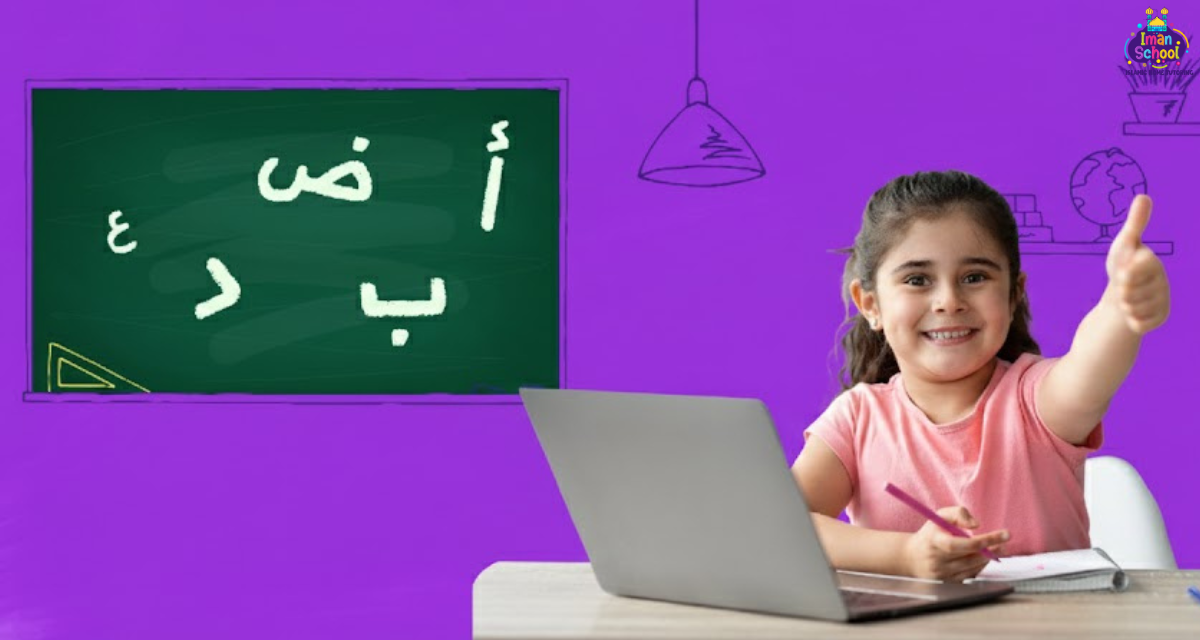
Personal pronouns are the building blocks of conversation, making them a crucial part of Easy Arabic Grammar for Kids. Focus on the four main single-person pronouns first:
-
Ana (أنا): I
-
Anta (أنتَ): You (masculine)
-
Anti (أنتِ): You (feminine)
-
Huwa (هو): He
-
Hiya (هي): She
Use role-playing and direct address to teach these Arabic pronouns for kids. Ask the child, "Who is Ana? Who is Anta?" This solidifies the concept of who is speaking and who is being addressed.
Past and Present Verbs: Simple Arabic Sentences for Children
Teaching Arabic verbs for kids should start with simple actions the child performs daily. Arabic verbs, unlike English, carry the pronoun within them (e.g., Akaltu means "I ate").
-
Past Tense: Focus on the third person masculine singular (e.g., Kataba - He wrote). The child then builds from this root.
-
Present Tense: Focus on the prefix changes (Ya-, Ta-, A-, Na-). Use physical movement to teach conjugation, asking them to act out the verbs: Aktubu (I write), Taktubu (You write). This keeps the simple Arabic sentence structure for kids active and engaging.
Demonstrative Pronouns: Learning 'This is' (Hādha / Hādhihi) in Arabic
Easy Arabic Grammar for Kids must include demonstrative pronouns (Asma' Al-Ishārah) because they are used constantly. Teach Hādha (هذا - This is, masculine) and Hādhihi (هذه - This is, feminine) by pointing to objects around the house.
Understanding this gender rule is the first step in Arabic demonstrative pronouns explained for children. For example, Hādha Kitāb (This is a book) versus Hādhihi Haqeebah (This is a bag). This helps reinforce Arabic noun agreement for kids visually.

Daily Arabic Phrases for Beginners to Use Every Day Get to know them
Colors and Shapes: Linking Arabic Vocabulary to the World Around Us
While not strictly grammar, learning learn Arabic numbers and colors for children is essential for grammar application, especially adjective-noun agreement. Teach colors like Ahmar (red) and shapes like Murabba' (square). This vocabulary is crucial when the child later learns that the adjective must match the noun in gender and definiteness, a core part of elementary Arabic grammar course.
Arabic Animals Names: Making Plural Fun for Kids
Use Arabic Animals Names to practice both vocabulary and the plural forms. Many animals use the irregular (broken) plural, so teaching them in small, themed groups with visuals helps simplify the complexity of Arabic singular and plural rules easy. This is a great way to combine fun Arabic grammar games with memory retention.
The Definite Article 'Al-' (ال): Easy Arabic Grammar for Kids on Simple Words
The definite article 'Al-' (ال) is perhaps the most fundamental element of Easy Arabic Grammar for Kids. It turns a general word (a book - Kitāb) into a specific word (the book - Al-Kitāb).
Introduce the concept of Sun Letters and Moon Letters as a fun sound distinction, without using the complex terminology. This Arabic definite article Al for kids lesson provides a simple way to practice pronunciation and is a core component of Arabic language basics for homeschoolers.
Simple Prepositions: How to Use 'In,' 'On,' 'From' in Arabic Sentences
Arabic prepositions for beginners are easy to teach using location. Prepositions (Ḥurūf Al-Jarr) like fī (في - in), 'alā (على - on), and min (من - from) are great for forming simple, practical sentences.
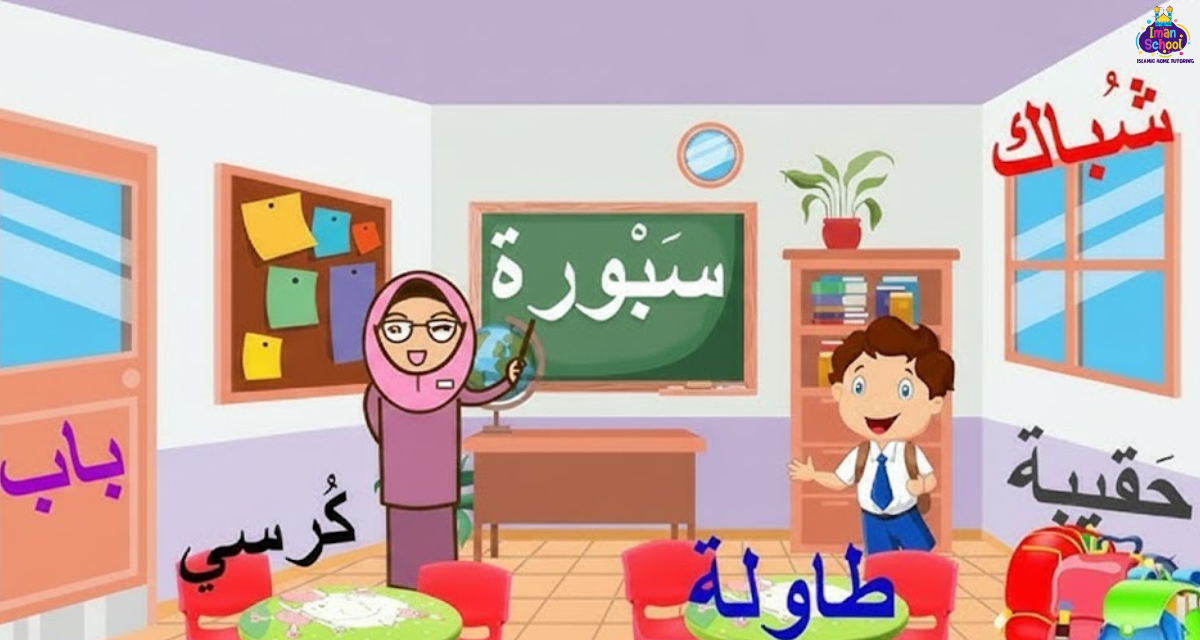
For example, Al-Qalam 'alā Al-Ṭāwilah (The pen is on the table). This teaches the child functional learn Arabic grammar for beginners by linking words to physical locations.
How to Learn Arabic Alphabet Easily from here
Basic Adjectives for Kids: Learning Big, Small, Long, and Short in Arabic
Arabic adjectives for children like Kabīr (big), Ṣaghīr (small), Ṭawīl (long), and Qaṣīr (short) are crucial for description. When teaching these Arabic adjectives for children, always pair them with the gendered nouns introduced earlier (e.g., Bāb Kabīr - Big door; Nāfidhah Kabīrah - Big window). This reinforces Arabic noun agreement for kids naturally.
Possessive Pronouns: Easy Arabic Grammar for Kids on 'My Book,' 'My Bag'
The concept of possession is simplified in Arabic by attaching suffixes (called Ḍamā'ir Al-Milkiyyah) directly to the noun. This is an elegant component of Easy Arabic Grammar for Kids.
Focus on the simple suffixes for "my" and "your":
-
Kitābī (كتابي): My book (by adding Yā' at the end).
-
Kitābaka (كتابك): Your book (masculine, by adding Kāf at the end).
This approach to Arabic possessive suffixes for beginners is far less confusing than using separate words, making it an easy way to learn Arabic grammar.
Is Arabic Hard to Learn? Discover that
FAQs about Easy Arabic Grammar for Kids
What is the best age to start teaching Arabic grammar to children?
The best age to start teaching learn Arabic grammar for beginners concepts naturally (through conversation and exposure) is around age 5 to 7. Formal, structured online Arabic grammar for children can begin effectively around age 8, when they start developing abstract reasoning.
Is it better to teach Modern Standard Arabic (MSA) grammar first?
Yes, teaching Modern Standard Arabic (MSA) grammar is essential. MSA provides the standardized rules, vocabulary, and structure necessary for reading the Qur'an and accessing all other simple Arabic sentence structure for kids materials.
How do I make Arabic grammar fun and not just memorization?
Use fun Arabic grammar games, visual aids, songs, and physical movements (Total Physical Response, or TPR). Always connect the grammar concept to a real-life object or action. This makes the teaching Arabic grammar to non-native speakers process engaging.
Do I need to teach the Arabic case endings (I'rab) to children?
No. The complexities of I'rab (case endings) are typically reserved for advanced learn Arabic grammar for beginners students (teens or older). Focus on the core structure, agreement, and function of the words first.
What online resources offer easy Arabic grammar exercises for kids?
Many educational platforms, like Iman School, offer dedicated online Arabic grammar for children modules with interactive quizzes and exercises that provide instant feedback.
Enroll Your Child in Our Online Foundational Arabic Grammar Course Today
Moving from single words to fluent conversation requires a strong grasp of Easy Arabic Grammar for Kids. Don't let your child struggle with scattered lessons or confusing resources.
Iman School specializes in teaching Arabic language basics for homeschoolers and Muslim families in the West. Our foundational Arabic Grammar Course is designed specifically to simplify complex rules using engaging, child-friendly methods.
We offer:
-
Certified Native Tutors: Expert in teaching Arabic grammar to non-native speakers.
-
Structured Curriculum: Covering all easy Arabic grammar for kids concepts systematically.
-
Interactive Lessons: Making learn Arabic grammar for beginners fun, not frustrating.
Enroll your child in Iman School today and watch them confidently build their first Arabic sentences.